Smart glasses: the CNIL calls for vigilance
29 June 2026
The rise of smart glasses is a new challenge for privacy and raises strong ethical and societal questions. The CNIL warns of these risks, which require collective vigilance, and launches its action plan.
Smart glasses, an "augmented" everyday object
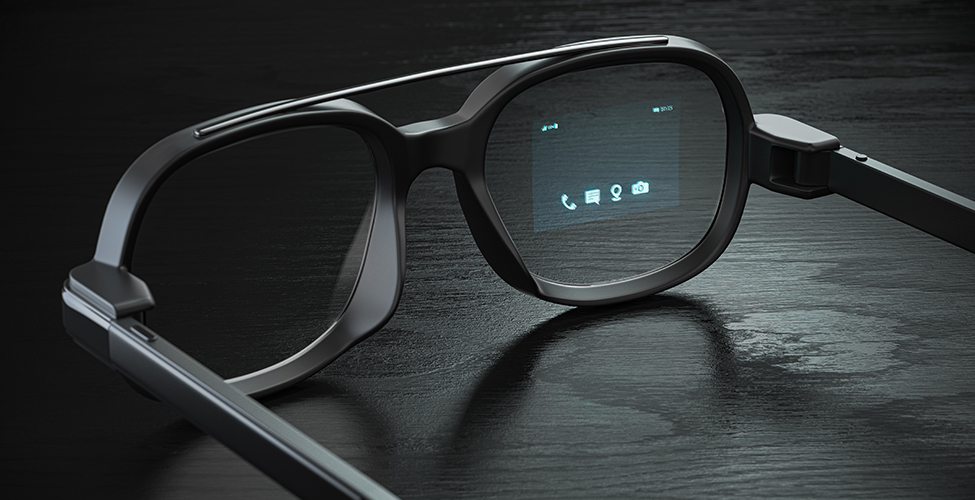
Smart glasses are ‘classic’ glasses or sunglasses, which have the particularity of being equipped with sensors within their frame (microphone and camera) and which are connected to the wearer’s mobile phone, often through a specific mobile application. They make it possible to use the smartphone’s functionalities (making a call, listening to music, taking photos and videos), some of which can be triggered by voice command.
These glasses are also often linked to an artificial intelligence system, which allows their wearer to ask questions to a chatbot, being either general questions (‘what is the weather today?’) or questions related to the wearer’s environment (‘describe what I see’ or ‘translate what the person in front of me says’). In order to be able to answer, the AI system triggers, where appropriate, the sensors of the glasses (e.g. the camera to take a picture of what the wearer of the glasses sees or the microphone to record what a person nearby says, etc.).
In addition, some manufacturers are developing devices capable of operating without a mobile phone: the glasses would incorporate a screen, enabling information to be displayed to the wearer, and their use would be controlled by a tool based on neuro-technologies, such as a bracelet which detects and interprets hand gestures.
An innovation that stirs curiosity while generating a sense of mistrust and worries
At the beginning of 2026, the CNIL launched a survey to explore how French people perceive and relate to smart glasses, in a context where such devices are becoming increasingly widespread. This survey took the form of an online survey, from 22nd to 29th January 2026, of a sample of 2 128 people representing the French population aged over 18.
The results show that a vast majority of people find that smart glasses pose a risk to people’s privacy (67% of respondents) and also give rise to many apprehensions about these devices: distrust, unease, worry or even annoyance.
Concerns relate in particular to people’s right to image and their consent, possible misappropriations in particular with the help of artificial intelligence (e.g. with deepfakes) as well as to the fate of data collected with glasses.
An innovation that raises important challenges in terms of privacy protection
Smart glasses involve many processing of personal data. Their use is, in principle, subject to the GDPR and the French data protection law (loi "Informatique et Libertés"). Beyond this legal framework, they raise broader risks to privacy and significant ethical as well as societal issues that go beyond the CNIL’s power alone.
A possible capture of the image and voice of third parties in an almost invisible way
By their very operation, smart glasses are capable of capturing sounds, images and videos of people in close proximity to the wearer, sometimes without these persons being fully aware of it. Indeed, since they are not clearly distinguishable from "classic" glasses, it is very difficult for people around to know whether they are being filmed or recorded. In addition, technical devices to inform people of a recording (e.g. activation of a light) have only a limited range and therefore appear insufficient, and are even absent for certain uses.
By facilitating the capture of data from an everyday object which does not usually have that purpose, those devices can be considered particularly intrusive. Unlike a mobile phone that you would have to take out and orient, and which only sees what its user shows it, glasses film everything what their wearer is looking at. There is therefore a significant risk that glasses will not be identified as smart glasses by people in their environment, who might be recorded. This also represents a fundamental shift in perspective brought about by the unique nature of "wearable computing" devices, which can remain constantly connected.
A high risk of constant surveillance
The rise of smart glasses could give rise to a significant risk of widespread surveillance and its trivialisation: any person could potentially be equipped with a camera in all public (streets, shops, beaches, etc.) and private (home, workplaces, etc.) spaces. The relatively moderate cost of these devices could lead to a saturation of the social space by sensors.
This shift from fixed, regulated and supervised surveillance (the ‘video protection’ we all know and are able to identify) to mobile surveillance, which is almost invisible and ubiquitous, could lead to a profound transformation of our societies.
In the long run, anyone could thus constantly doubt a potential recording of their every move and exchange, creating the feeling of being constantly observed or even monitored, and gradually creating a form of permanent self-censorship. This would directly threaten the exercise of individual freedoms (freedoms of expression, assembly and demonstration).
Moreover, the possible use of these devices in places where a high degree of privacy is expected (medical offices, changing rooms, toilets) raises new ethical and legal issues. The emergence of these technologies in any private space where respect for privacy is the norm could have significant consequences for the social interactions between citizens, or even lead to abuses.
CNIL calls for enhanced collective vigilance
Smart glasses are not just technological tools. By their ability to capture, process and interpret data in real time, without the people around them necessarily being aware of it, they pose major risks to privacy.
If the promoters of the devices highlight their usefulness, particularly for people with disabilities (visual or hearing assistance), as well as their contributions in terms of translation, it nonetheless remains the case that their deployment must not be at the expense of everyone's rights and freedoms. It is necessary to maintain a balance between innovation and respect for freedoms, between technical curiosity and consideration of others. This vigilance, observed by all, is the condition for such devices to remain useful auxiliaries – not intrusive tools.
Article 9 of the Civil Code guarantees a right to privacy in all places, private and public, and any violation of this right may be punished. Article 226-1 of the Penal Code punishes by one year's imprisonment and a fine of €45,000 the violation of someone’s privacy by fixing, recording or transmitting the image of a person in a private place without their consent.
Any user of smart glasses must therefore respect the right to privacy of persons whose image or voice may be captured by glasses and, where appropriate, obtain their consent.
CNIL launches an action plan on smart glasses and publishes first good practices
Taking into account the results of the survey, which give rise to concerns among the respondents, and in view of the importance of the legal, ethical and societal issues raised by their use, the CNIL decided to launch work on the compliance of smart glasses with regard to the protection of personal data:
- Legal and technical issues require in-depth analysis. As these arrangements are developing at international level, the CNIL wishes to engage in discussions with its European counterparts to carry out this work at the European data protection board (EDPB) level.
- As issues go beyond data protection, the CNIL wishes to exchange with other competent public authorities on these issues.
- In order to feed into these reflections and works, as well as for awareness-raising purposes, the CNIL plans to address the subject of smart glasses at its forthcoming events. The information on this subject will be specified in the communications relating to these various events.
In any case, and as of now, the CNIL recommends users to observe the following good practices:
- Inform people nearby when using smart glasses;
- Disable the glasses’ functions as soon as they are no longer useful;
- Turn off your smart glasses whenever you are asked to turn off your cell phone;
- Avoid using glasses in places where people do not expect them;
- Be sure to get every person’s consent if you want to use photos or videos where they appear, for example to post them on your social networks. You must respect their right to the image (for more information: https://www.economie.gouv.fr/apie/droit-limage-des-persones-et-des-biens).
- Think before you share: a publication, even if innocuous, can have lasting effects for people.